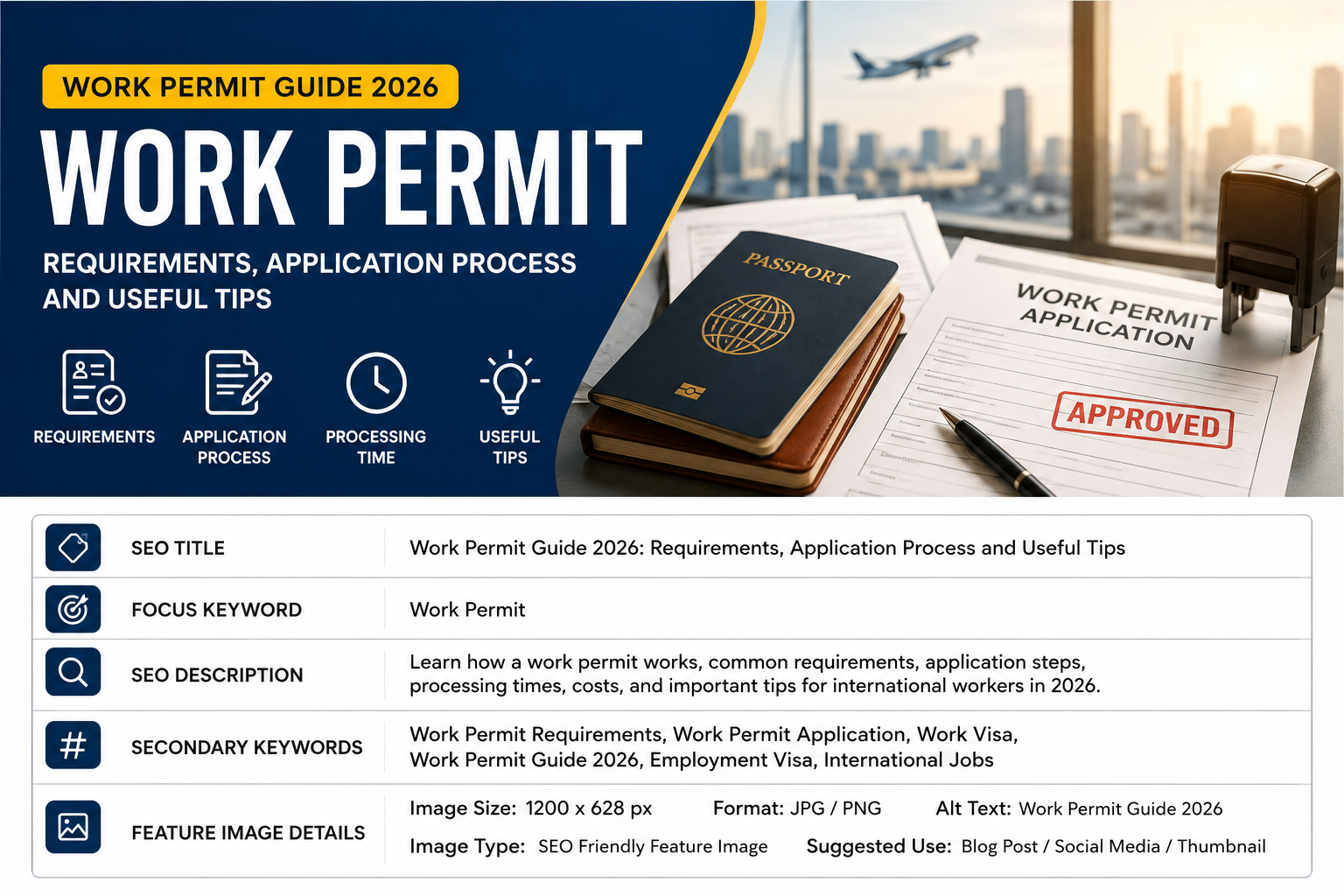
Work Permit Guide 2026: Requirements, Application Process, and Useful Tips
Getting the opportunity to work in another country can be a step toward a better career and a new experience. However, before starting a job, most foreign workers need to understand the country’s immigration rules and obtain the correct permission to work. In some countries, this permission is known as a work permit.
A work permit is an authorization that allows a foreign national to work legally in a particular country. The exact requirements, application process, fees, and conditions depend on the country, type of job, employer, and applicant’s situation.
This guide explains the basics of work permits in simple language. Whether you are looking for a sponsored job, planning to work temporarily, or preparing for a career, understanding the process can help you avoid common mistakes.
What Is a Work Permit?
A work permit is a document or authorization that gives a foreign worker permission to work in a country where they do not normally have the right to work.
For example, a person who wants to work in another country may need permission from that country’s immigration authority before starting employment. In some cases, the work permit is connected to an employer or job. In some situations, the permit may provide broader employment rights.
It is important to understand that a work permit and a visa are not always the same thing.
A visa may allow you to enter or stay in a country, while a work permit or employment authorization may determine whether you can legally work there. Some countries combine these permissions into one immigration document, while others use separate processes.
Why Do You Need a Work Permit?
Working without the required authorization can create immigration and employment problems. Depending on the country’s laws, unauthorized employment may result in penalties, cancellation of immigration status, removal from the country, or difficulty obtaining visas.
A valid work permit helps demonstrate that you have permission to perform the type of employment covered by your authorization.
It can also protect workers by making the terms of employment clearer. Depending on the laws, authorized workers may have rights relating to wages, working conditions, contracts, and workplace protections.
For this reason, applicants should always check the immigration rules before accepting a job abroad.
Common Types of Work Permits
Work permit systems vary around the world. Several common categories appear in different countries.
Employer-Sponsored Work Permit
An employer-sponsored work permit is one of the common routes for foreign workers. In this situation, a company offers employment and may need to complete part of the immigration process.
The employer may have to prove that the position meets requirements related to recruitment, wages, business operations, or labor market rules.
Because the permit can be connected to an employer, workers should carefully understand what happens if they change jobs.
Temporary Work Permit
Some countries provide permits for workers who intend to work for a limited period.
These permits may be available for temporary employment, projects, skilled positions, or specific industries. The permit normally has an expiration date. Workers may need to apply for an extension if they are legally allowed to remain and continue working.
Skilled Worker Permit
Countries sometimes create immigration programs for workers with qualifications or experience in occupations that are in demand.
Applicants may need to meet requirements related to education, professional experience, salary, language ability, or an employment offer.
The exact criteria can change, so applicants should check the requirements before applying.
Open Work Permit
An open work permit, where available, can provide flexibility because it may not be restricted to one particular employer.
However, open permits are usually available to people who meet specific eligibility conditions. Not every foreign worker can apply for this type of authorization.
General Work Permit Requirements
Work permit requirements depend on the destination country and immigration program. However, applicants commonly need certain types of documents.
These may include:
* A valid passport
* A genuine job or employment contract
* Employer information
* Proof of qualifications
* Educational certificates
* Evidence of work experience
* Proof of support where required
* Passport-size photographs
* Medical examination where applicable
* Police or background certificates, where required
* Proof of language ability for programs
* Completed immigration forms
* Government application fees
Not every applicant will need every document on this list.
One of the important steps is checking the official requirements for your specific work permit category. Submitting documents that are incomplete, outdated, or inconsistent can delay an application.
How to Apply for a Work Permit
The work permit application process usually follows basic stages, although the exact procedure differs by country.
Step 1: Find an Eligible Job
The first step for applicants is finding employment that qualifies under the relevant immigration program.
If you are applying through employer sponsorship, make sure the employer is legally permitted to sponsor workers when sponsorship is required.
Do not assume that every job advertised online automatically qualifies for a work permit.
Step 2: Check Your Eligibility
Before submitting an application, review the requirements.
Check your age, education, professional experience, language ability, job offer, salary, and other conditions that may apply to your chosen immigration route.
Understanding eligibility before paying an application fee can save time and money.
Step 3: Prepare Your Documents
Collect all required documents before beginning the application whenever possible.
Make sure names, dates, job titles, education information, and other important details are consistent across your documents. If documents are not in the required language, you may need an approved translation.
Keep copies of everything you submit.
Step 4: Submit the Application
Some countries allow applicants to apply online through an official immigration portal. Some applications may require an appointment at a visa application center, embassy, consulate, or another authorized location.
Follow the instructions carefully. Provide truthful information.
Step 5: Complete Biometrics or Medical Checks
Depending on the country and immigration category, you may be asked to provide fingerprints, photographs, medical examination results, or other information.
If these steps are required, do them within the deadline provided by the immigration authority.
Step 6: Wait for a Decision
After submission, the immigration authority reviews the application.
Processing times can vary significantly. Some applications may be processed quickly, while others can take considerably longer because of additional checks, missing documents, application volumes, or individual circumstances.
Applicants should avoid making travel or employment decisions based on an estimated processing time.
How Much Does a Work Permit Cost?
There is no worldwide work permit fee.
The total cost may include a government application fee, biometric fee, medical examination, document translation, police certificate, or other required services.
Some employers may pay immigration-related costs, while other expenses may be the responsibility of the applicant. The rules depend on the country and employment program.
Always check the official fee schedule before making a payment. Avoid websites or individuals that promise a guaranteed work permit in exchange for high fees.
How Long Does a Work Permit Take?
Processing time depends on several factors.
These can include the type of work permit, country, applicant’s nationality, employer requirements, background checks, application volume, and whether the submitted documents are complete.
A complete application can generally help prevent delays, but no applicant should assume that approval is guaranteed within a specific number of days.
If an immigration authority requests additional information, responding within the stated deadline is important.
Common Work Permit Mistakes to Avoid
Problems can be avoided by preparing carefully.
One common mistake is submitting an application without checking whether the job actually qualifies for the selected immigration program.
Another mistake is providing inconsistent information. Even a small difference between an application and supporting documents can create questions during processing.
Applicants should also be careful with job offers. Scammers sometimes advertise overseas jobs and ask applicants for large upfront payments.
Never assume that a job offer is genuine simply because it contains a company logo or looks professional.
Research the employer independently. Use official immigration resources whenever possible.
Can You Change Employers on a Work Permit?
This depends entirely on the type of permit.
Some work permits are linked to an employer. In these cases, changing jobs may require a new application or additional immigration approval before the worker can begin employment with another company.
Other permits may provide flexibility.
Before accepting a job, workers should check the conditions printed on their permit and the current immigration rules. Starting a position without the required authorization can create legal and immigration problems.
Work Permit vs Work Visa
The terms work permit and work visa are often used together. They can have different meanings.
A work visa may relate primarily to entering or remaining in a country for employment purposes. A work permit may refer specifically to authorization to work.
The terminology differs between countries, so applicants should focus on the immigration category rather than relying only on the name used in advertisements.
Tips for a Work Permit Application
A careful application is usually better than a rushed application.
Start by identifying the immigration category. Then read the requirements and prepare your documents accordingly.
Make sure your passport is valid and that your personal information is consistent throughout the application. Keep physical copies of important documents.
If an employer is involved, communicate with the employer’s resources or immigration team and ask questions about sponsorship and employment conditions.
Importantly, do not provide false information. Immigration authorities can verify details, and false statements can have serious consequences.
Final Thoughts
A work permit can provide a legal pathway for people who want to build their careers in another country. However, getting permission to work is not simply about finding a job and submitting a form. Applicants need to understand the immigration category, eligibility requirements, documentation, fees, and conditions attached to their permit.
The process can seem complicated at first. Proper preparation makes it easier to understand each stage. Always use government immigration information for the latest rules because requirements, fees, processing procedures, and eligible occupations can change.
If you are planning to work in 2026, take time to research your destination country, verify the employer and job offer, prepare accurate documents, and apply through the appropriate official channel.
A genuine job opportunity combined with work authorization can be the foundation for a successful international career. The key is to make decisions carefully and never rely on promises of guaranteed approval.