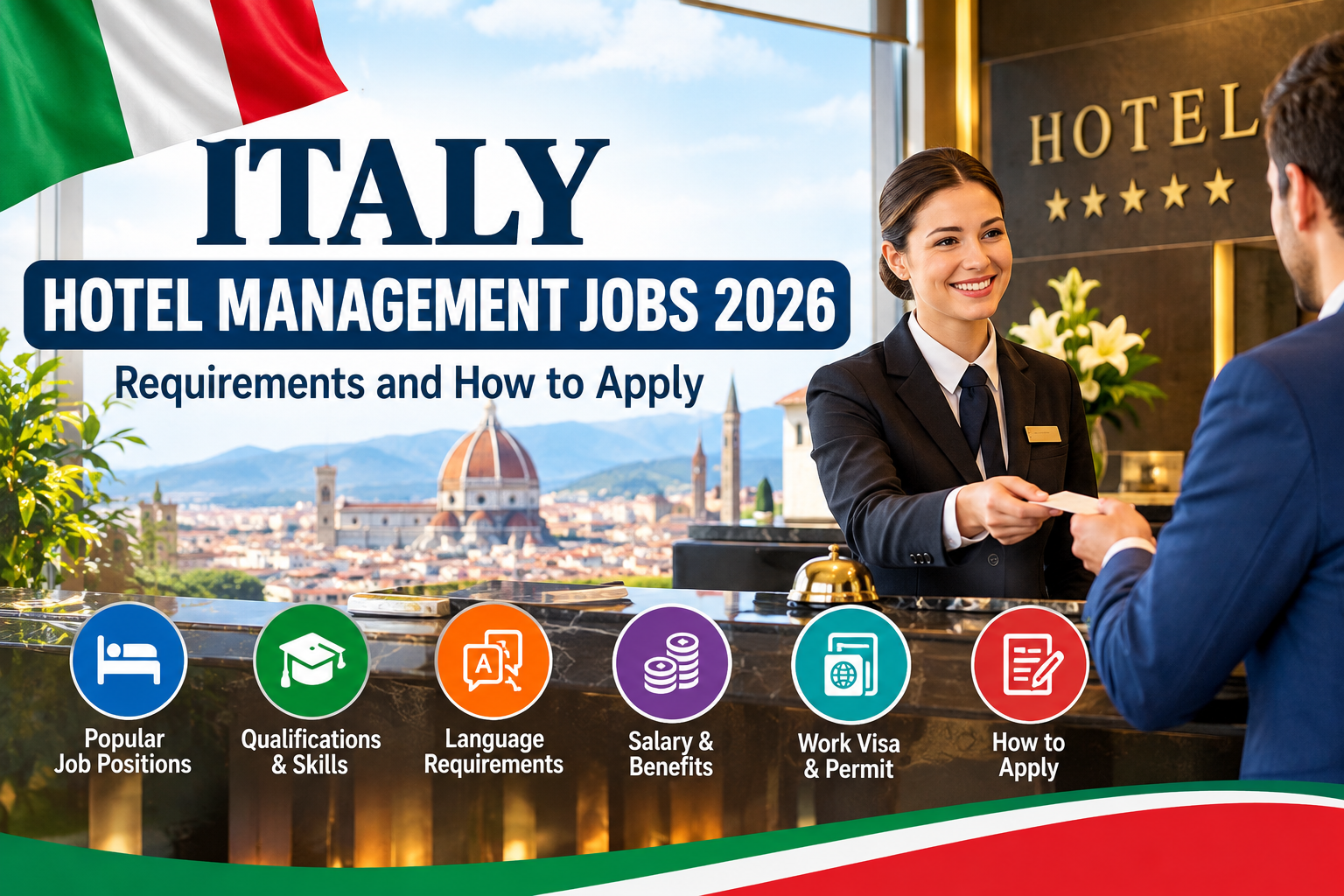
Italy Hotel Management Jobs 2026: Career Opportunities, Requirements, and How to Apply
Italy is one of the world’s most popular travel destinations, attracting millions of visitors every year. From historic cities and luxury resorts to coastal destinations and family-owned hotels, the country’s hospitality industry offers a wide range of career opportunities. For qualified professionals, Italy hotel management jobs in 2026 can provide a valuable opportunity to build international experience and develop a long-term career in the hospitality sector. The demand for hospitality services is connected with the large number of visitors who travel to Italy for holidays, business, culture, and other purposes.
Hotel management is not limited to one specific position. Hotels need professionals who can manage daily operations, guest services, food and beverage departments, housekeeping teams, reservations, sales, and administration. International applicants with relevant education, practical experience, and good communication skills may find opportunities in different areas of Italy’s hospitality industry. Hotel management requires people who can understand daily hotel operations while also dealing with guests, employees, and business responsibilities.
Why Consider Hotel Management Jobs in Italy?
Italy has a diverse tourism industry. Major destinations such as Rome, Milan, Venice, Florence, Naples, and the Amalfi Coast attract visitors throughout the year. Seasonal tourism also creates demand for hospitality workers in resorts, restaurants, hotels, and other accommodation businesses. The variety of destinations means that hospitality professionals may find different types of working environments, from large city hotels to smaller properties in popular tourist areas.
Working in Italy can also provide international experience. Hotel management professionals can develop skills in customer service, team leadership, business administration, event management, and hospitality operations. Experience gained in an international environment may be useful for future career opportunities in Europe and other countries. Working with guests from different backgrounds can also help hospitality professionals improve communication, customer service, and workplace skills.
The hospitality sector can require employees to handle different responsibilities during busy periods. Hotel managers and other experienced workers may need to coordinate departments, respond to guest concerns, organize staff responsibilities, and help maintain the daily standard of hotel services. These responsibilities can help professionals develop a broader understanding of the hospitality industry.
Popular Hotel Management Jobs in Italy
The Italian hospitality industry offers positions for people with different levels of education and experience. Some common hotel management and related positions include:
- Hotel Manager
- Assistant Hotel Manager
- Front Office Manager
- Guest Relations Manager
- Reservations Manager
- Food and Beverage Manager
- Restaurant Manager
- Housekeeping Manager
- Sales and Marketing Manager
- Events Coordinator
- Reception Supervisor
- Hospitality Operations Supervisor
Each position has different responsibilities. A hotel manager may be responsible for overseeing general hotel operations, while an assistant hotel manager may support the manager with daily activities. A front office manager normally works closely with reception and guest services. A guest relations manager focuses on guest needs and service standards.
A reservations manager can be responsible for managing bookings and reservation activities. Food and beverage managers and restaurant managers may supervise food and beverage services. A housekeeping manager can coordinate housekeeping employees and room-related operations. Sales and marketing managers can work on attracting customers and supporting the hotel’s business activities.
Entry-level applicants may also find opportunities as receptionists, guest service assistants, restaurant staff, housekeeping employees, or hotel trainees. With experience and additional training, employees can progress into supervisory and management positions. Starting in an entry-level role can help employees understand hotel operations before taking on greater responsibilities.
Qualifications and Skills Required
Requirements depend on the employer and the specific position. Management-level jobs generally require relevant education or professional experience in hospitality, hotel management, tourism, business administration, or a related field. The exact requirements can differ according to the position, the size of the hotel, and the responsibilities involved.
Employers may look for candidates who have strong organizational and leadership skills. Communication is particularly important because hotel managers regularly interact with guests, employees, suppliers, and business partners. A manager needs to communicate information clearly and help different departments work together.
Other valuable skills include problem-solving, customer service, time management, teamwork, financial awareness, and the ability to work under pressure. Hotel environments can become busy, especially during periods of high tourism. Employees may need to respond quickly to guest requests while continuing to manage their regular responsibilities.
Experience with hotel reservation systems, property management software, accounting tools, or hospitality technology can also improve a candidate’s profile. Knowledge of these systems can be useful because modern hotels depend on technology for reservations, administration, guest information, and other daily operations.
Practical experience can be especially useful for management positions. Candidates who have worked in hotels or related hospitality environments may already understand guest service, workplace communication, and the responsibilities involved in managing hotel operations.
Language Requirements
Italian language skills can be highly valuable when applying for hotel management positions in Italy. Although some international hotels use English extensively, managers often need to communicate with local employees, suppliers, authorities, and Italian-speaking guests. Good Italian communication skills can therefore make daily workplace communication easier.
English is also important in hotels that serve international tourists. Candidates who can communicate confidently in both Italian and English may have an advantage. Knowledge of another language, such as German, French, or Spanish, can also be useful in tourism environments.
Language requirements can vary from one employer to another. An international hotel may have more English-speaking guests and employees, while a smaller local hotel may require stronger Italian communication. Applicants should carefully review the language requirements mentioned in each job advertisement.
Good communication is not only about speaking. Hotel professionals also need to listen carefully, understand guest concerns, provide clear information, and communicate with colleagues. These skills can be important in both entry-level and management positions.
Salary and Employment Benefits
Hotel management salaries in Italy vary according to job title, experience, location, employer, and property type. A management position at a luxury hotel in a major tourist destination may offer different compensation from a similar position at a small independent hotel. Experience and responsibilities can also affect the salary offered by an employer.
Some employers may provide benefits depending on the employment contract. These can include paid leave, meals, staff accommodation, training opportunities, bonuses, or other employment benefits. However, benefits are not necessarily the same for every position, so applicants should review the complete employment offer carefully.
Applicants should carefully review the employment contract before accepting an offer. Salary, working hours, overtime arrangements, accommodation, benefits, and other conditions should be clearly understood. Candidates should make sure that the terms of employment are clear before making travel or other arrangements.
Working hours can also vary in the hospitality industry. Hotels operate for long hours, and some properties operate throughout the day and night. Depending on the position, employees may work evenings, weekends, holidays, or during busy seasonal periods.
Work Visa and Permit Considerations
International applicants who are not citizens of the European Union generally need appropriate authorization to work legally in Italy. The exact process depends on nationality, employment situation, and the applicable Italian immigration rules. Applicants should understand the relevant requirements before planning to work in Italy.
A job offer alone does not automatically give a foreign worker permission to work. Applicants should check the latest requirements through official Italian government or immigration resources before making travel or employment arrangements. Work authorization requirements can depend on the applicant’s circumstances and the type of employment.
Candidates should also be careful with recruitment advertisements that promise guaranteed visas or jobs in exchange for large upfront payments. A legitimate employer should provide clear information about the position, contract, salary, and recruitment process.
Applicants should verify employment information carefully. They should understand who the employer is, what position is being offered, what the employment conditions are, and what documents are required. Taking time to check these details can help applicants avoid misleading recruitment offers.
How to Find Hotel Management Jobs in Italy
Job seekers can search through reputable employment websites, hotel company career pages, recruitment agencies, and professional networking platforms. Searching by specific job title and location can make the process more effective. Applicants can search for positions that match their education, experience, language skills, and preferred type of hotel.
Candidates should prepare a professional CV that highlights education, hospitality experience, management responsibilities, language abilities, and relevant technical skills. A clear CV allows employers to understand the applicant’s background and experience.
A concise cover letter can also explain why the applicant is interested in the position and why their background matches the employer’s requirements. The cover letter should be related to the position and should clearly present the candidate’s relevant experience and skills.
Before applying, applicants should research the hotel and verify that the vacancy is genuine. Checking the employer’s official website and contact information can help reduce the risk of fraudulent recruitment offers. Applicants should also compare information in the job advertisement with information provided by the employer.
Searching by location can also help candidates focus their applications. Italy has major tourism destinations as well as smaller areas with hotels and resorts. Candidates can consider positions according to the type of property and the responsibilities listed in the vacancy.
Tips for International Applicants
International candidates should focus on presenting their experience clearly and professionally. Hospitality employers often value practical experience because hotel operations require strong customer service and problem-solving abilities. Candidates should explain their previous responsibilities instead of simply listing job titles.
Candidates should also be prepared for interviews that may assess leadership, communication, conflict resolution, guest relations, and operational knowledge. Interview questions may focus on how a candidate would handle guests, manage employees, solve workplace problems, or respond during busy periods.
Learning Italian can improve workplace communication and demonstrate commitment to working in Italy. Even when English is used regularly, Italian can be useful when communicating with local employees, suppliers, guests, and other people connected with hotel operations.
It is also important to understand that hotel work may involve weekends, holidays, evening shifts, and busy seasonal periods. Flexibility is therefore an important quality for hospitality professionals. Candidates should understand the working schedule before accepting a position.
Applicants should also make sure that their CV contains accurate information. Education, work experience, language skills, and other qualifications should be presented clearly. Accurate information can make the application more professional and easier for an employer to review.
Career Growth in Italy’s Hospitality Industry
Hotel management can offer several opportunities for career development. An employee may begin in an operational role and gradually move into supervisory, departmental, and management positions. Career progress can depend on experience, training, performance, responsibilities, and the needs of the employer.
Professionals who gain experience in different departments can develop a broader understanding of hotel operations. Working in guest services, reservations, housekeeping, food and beverage, or administration can help employees understand how different departments work together.
Additional qualifications, language skills, leadership experience, and knowledge of modern hospitality technology can further support career progression. Employees who continue developing their professional skills may become better prepared for positions with greater responsibilities.
Italy’s strong tourism sector also allows professionals to gain experience in different types of properties, including city hotels, luxury resorts, boutique hotels, business hotels, and seasonal accommodation. Each type of property can provide different working experiences and responsibilities.
Career development in hotel management can therefore involve gradual progress. An employee may begin with daily operational responsibilities, gain practical experience, take on supervisory duties, and later move into management. The exact path depends on the individual’s skills, experience, qualifications, and employment opportunities.
Final Thoughts
Italy hotel management jobs in 2026 can be an attractive option for hospitality professionals seeking international career experience. The industry offers opportunities across hotel operations, guest services, food and beverage, reservations, sales, administration, and management. Different positions are available for candidates with different levels of education and experience.
Success in Italy hotel management jobs in 2026 requires appropriate qualifications, practical experience, strong communication skills, and an understanding of employer requirements. International applicants should also carefully research work authorization rules and verify every job opportunity before accepting an offer.
Candidates should prepare a professional CV, understand the requirements of each position, and carefully review employment conditions. Italian and English language skills can be useful, particularly for professionals who want to work with both local and international guests.
With the right preparation, a professional CV, relevant skills, and realistic expectations, Italy can provide valuable opportunities for people who want to develop a career in the international hospitality industry. Italy hotel management jobs in 2026 can therefore be considered by qualified hospitality professionals who are prepared to meet the requirements of employers and work in a busy tourism environment.