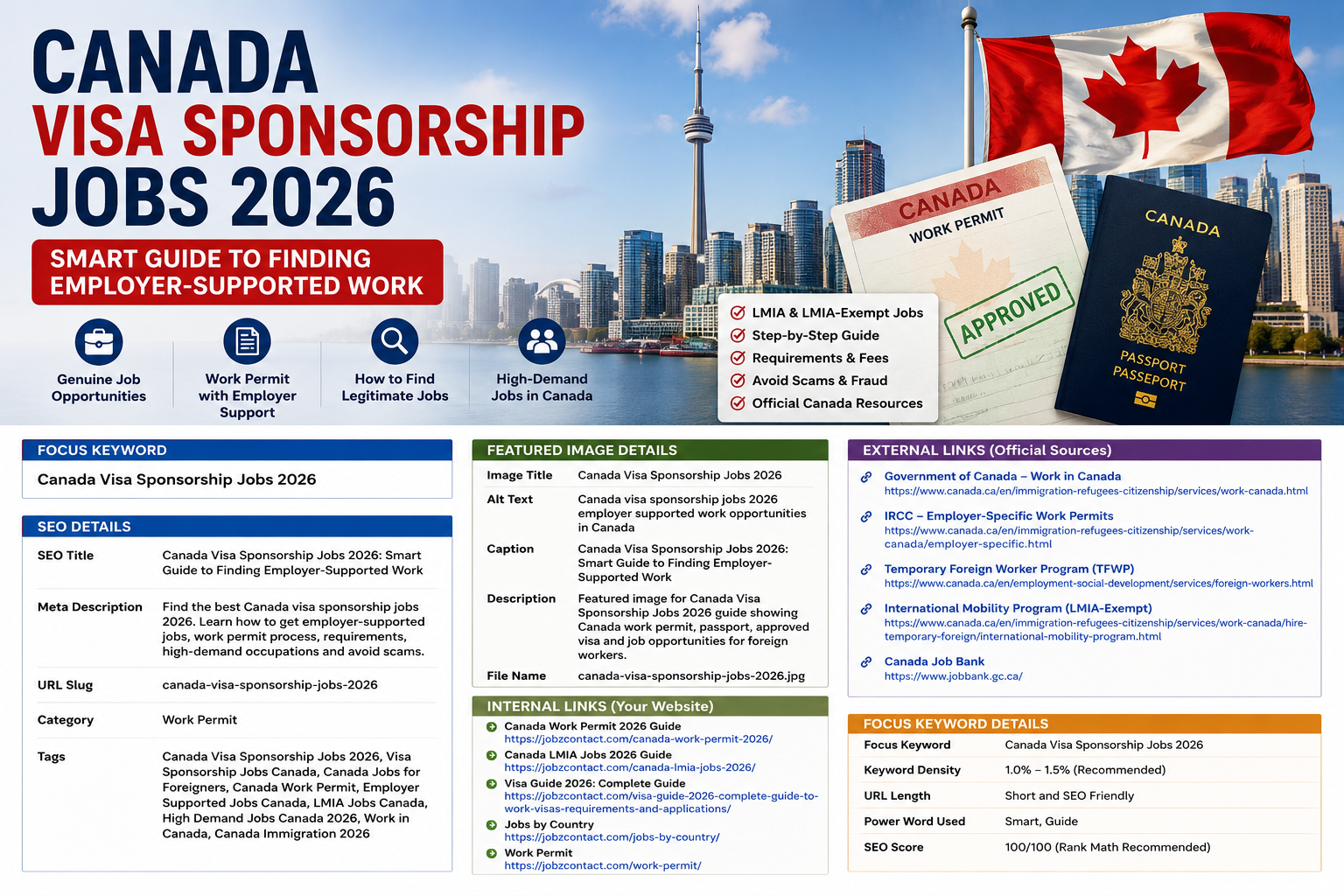
Canada Visa Sponsorship Jobs 2026
Finding a job in Canada from another country can be very exciting. You need to understand how work permits really work in Canada. Many people looking for jobs in Canada search for Canada visa sponsorship jobs in 2026 because they want a company that can help them get a work permit.
The term “visa sponsorship” is used a lot online. Canada’s immigration system is actually based on specific work permit rules. Depending on the job and the person’s situation, a company may need a Labor Market Impact Assessment (LMIA). The job may not need an LMIA.
This guide explains how jobs with company support work in Canada in 2026, where to find job opportunities, what companies and workers need to do, which jobs may offer opportunities, and how to avoid fake job offers.
Important: Having a job offer, LMIA, or company support does not mean you will automatically get a visa or work permit. You must meet the immigration requirements. Always check the latest information from the Canadian government.
What Does Visa Sponsorship Mean in Canada?
The term “visa sponsorship” is widely used by people looking for jobs to describe a company that is willing to support a foreign worker’s immigration process.
However, Canada does not have a program called a “visa sponsorship job.”
For company-specific work permits, the process involves getting a real job offer from a Canadian company. If the job requires an LMIA, the company must complete the LMIA process before the worker applies for the work permit.
Some jobs do not need an LMIA under immigration programs.
The key point is that the company may support the work permit process, but the final decision is made based on Canada’s immigration rules.
How Employer-Supported Work Permits Work in 2026
A company work permit allows a foreign worker to work under the conditions listed on the permit. These conditions can include the company, job, and location.
To get a company work permit, you generally need a job offer from a company that is not on Canada’s list of non-compliant companies and must meet the general requirements for a work permit.
If an LMIA is required, the company must get it and give the worker the necessary documents for the work permit application.
The process can be divided into two parts:
- Company side. The company completes the hiring process.
- Worker side. The foreign worker applies for the work permit and shows they are eligible.
This is why a real job offer is important. It is not the same as a guaranteed visa.
LMIA Jobs vs. LMIA-Exempt Jobs
There are two routes that job seekers should understand.
LMIA-Supported Jobs
A Labor Market Impact Assessment is used to determine if there is a need for a temporary foreign worker to fill a job.
For LMIA-required jobs, the company must show recruitment efforts and meet wage, employment, and other program requirements.
The company is responsible for the LMIA application.
LMIA-Exempt Jobs
Some Canadian companies can hire workers without an LMIA through the International Mobility Program or another specific exemption.
These exemptions are based on immigration categories and are not available for every job.
The International Mobility Program allows eligible companies to hire temporary foreign workers without an LMIA.
For this reason, job seekers should not assume that every company-sponsored position requires an LMIA.
Who Can Apply for Employer-Supported Jobs?
There is no requirement for every sponsored job.
Your eligibility can depend on:
- Your job
- Work experience
- Education or training
- Job offer
- Language ability, where required
- Professional licensing
- Company eligibility
- Wage offered
- Province or territory
- LMIA requirements
- Your immigration history
- The type of work permit
For regulated professions, you may need provincial or territorial licensing before you can legally perform certain duties.
Applicants should also ensure that their resume and employment documents accurately represent their qualifications.
Popular Areas for Canada Visa Sponsorship Jobs in 2026
Job availability changes all the time. No job should be considered automatically “sponsored.” However, foreign-worker recruitment can happen across industries.
1. Healthcare and Support Services
Canada’s healthcare system employs professionals and support workers across different regions.
Potential employment areas include:
- Nursing
- Personal support services
- Healthcare assistance
- Medical laboratory occupations
- Pharmacy-related roles
- Other healthcare professions
Requirements can be strict for healthcare occupations, particularly because licensing and credential recognition may be necessary.
2. Construction and Skilled Trades
Construction and trades can offer opportunities for workers.
Examples include:
- Carpenters
- Welders
- Electricians
- Plumbers
- Heavy equipment operators
- Construction workers
- Industrial mechanics
Applicants should check whether the job is regulated in the province where they intend to work.
3. Transportation and Trucking
Transportation is another sector frequently searched by job seekers.
Potential occupations may include:
- Truck drivers
- Transport-related workers
- Heavy equipment operators
- Logistics-related positions
Commercial driving positions normally require Canadian licensing and experience requirements.
4. Agriculture and Food Production
Agriculture and food production are employment sectors in several Canadian regions.
Possible positions include:
- Farm workers
- Greenhouse workers
- Harvest workers
- Livestock workers
- Food processing workers
- Production workers
Some agricultural jobs are covered by temporary foreign-worker arrangements, so applicants should check the exact program and company requirements.
5. Hospitality
Hotels, restaurants, and other hospitality businesses may recruit workers for roles such as:
- Cooks
- Kitchen helpers
- Food service workers
- Housekeeping staff
- Hotel workers
However, a company having difficulty recruiting locally does not automatically mean it can sponsor a worker.
6. Manufacturing and Production
Manufacturing companies may recruit for:
- Production workers
- Machine operators
- Welders
- Workers
- Packaging positions
- Maintenance roles
The availability of foreign-worker positions depends on the company, location, job, and applicable immigration rules.
How to Find Genuine Canada Visa Sponsorship Jobs
One approach is to start with reliable employment sources rather than social-media posts promising guaranteed visas.
The Government of Canada’s Job Bank is a resource for searching Canadian employment opportunities.
When reviewing a job advertisement, check:
- Company name
- Official company website
- Exact job location
- Job duties
- Salary or wage information
- Working hours
- Qualifications
- Application instructions
- Company contact information
A legitimate job should provide information for you to understand what you are applying for.
Do not choose a job solely because the advertisement contains the words “visa sponsorship.”
What Employers Need to Do
For company-supported employment, the Canadian company has responsibilities as well.
Depending on the program, the company may need to:
- Prove that the business is legitimate
- Provide a job
- Meet wage requirements
- Conduct recruitment
- Apply for an LMIA where required
- Submit an offer of employment for certain LMIA-exempt positions
- Meet workplace requirements
- Comply with foreign-worker rules
For LMIA applications, companies must follow the requirements of the applicable stream.
For example, current low-wage LMIA requirements include a minimum of 30 hours of work per week. The company generally pays a $1,000 processing fee per position requested.
The worker should not be asked to pay the company’s LMIA processing fee.
Canada Visa Sponsorship Jobs 2026: Low-Wage Positions
Low-wage positions have received attention because the Temporary Foreign Worker Program includes additional restrictions.
Current federal rules can restrict the processing of LMIA applications where a company’s proportion of temporary foreign workers exceeds applicable caps.
There are also temporary measures for eligible employers in certain rural areas.
As of 2026, some participating jurisdictions can allow eligible employers to increase the proportion of wages for temporary foreign workers from the standard 10% cap to 15%, while other temporary measures allow eligible employers to retain existing proportions above the normal cap. Participation varies by province and territory.
This is a reason to check the exact company, location, and job rather than assuming every advertised low-wage job can support a work permit.
New 2026 Recruitment Requirements
Canadian temporary foreign-worker rules continue to evolve.
The federal government announced changes affecting low-wage LMIA recruitment. Current government information says companies must advertise low-wage positions for 8 consecutive weeks compared with the previous 4-week requirement and must demonstrate adequate efforts to target youth in recruitment.
For applicants, this reinforces an important point: the company has to complete substantial recruitment and compliance steps before hiring a foreign worker through the applicable LMIA route.
Therefore, a social-media advertisement saying “LMIA available immediately” should not automatically be trusted.
How to Apply for a Sponsored Job in Canada
A practical application process can look like this:
Step 1: Prepare Your Canadian-Style Resume
Create a resume that focuses on your relevant experience, qualifications, and skills that can be measured.
You should never include work experience or qualifications on your resume that you do not have.
This is very important because it can cause problems for you.
Step 2: Search for Suitable Jobs
You can use employment platforms, company career pages, and the Government of Canada’s Job Bank to find jobs that are suitable for you.
These are places to start your job search.
Step 3: Apply Directly
You should follow the employer’s application process when you want to apply for a job.
If possible, you should verify the company through its website before sharing sensitive documents.
This will help you make sure that the company is real and that your documents are safe.
Step 4: Attend the Interview
A real employer may conduct phone, video, or in-person interviews depending on the position they are hiring for.
You should be prepared to explain your experience and qualifications during the interview.
This is your chance to show the employer that you are the right person for the job.
Step 5: Employer Completes the Required Process
If a Labor Market Impact Assessment is required, the employer will handle the application.
If the position does not require a Labor Market Impact Assessment, the employer may need to complete a process.
The employer will take care of this step.
Step 6: Apply for Your Work Permit
Once you have the required documents from your employer, you can apply for a work permit if you qualify.
Immigration, Refugees and Citizenship Canada’s current process for people outside of Canada includes checking if you’re eligible, preparing your documents, submitting your application, paying the required fees, providing biometrics when required, and waiting for a decision.
Documents You May Need
The exact documents you need will depend on your circumstances and the type of work permit you are applying for.
Some common documents that you may need include:
- A valid passport
- A job offer letter
- An employment contract
- Your resume
- Proof of your work experience
- Education or training documents
- Labor Market Impact Assessment documents if they are required
- An offer of employment number if it is required
- Photographs
- Biometrics if they are required
- Examination documents if they are requested
- Police certificates, if they are required
- Other documents that Immigration, Refugees and Citizenship Canada requests
For a Labor Market Impact Assessment-required application, Immigration, Refugees and Citizenship Canada currently lists the Labor Market Impact Assessment, Labor Market Impact Assessment file number, employment contract, and job offer letter as documents that the employer must provide.
How Much Does a Canada Work Permit Cost?
For people applying from outside of Canada, the current standard work permit processing fee is one hundred and fifty-five dollars unless you are exempt from paying this fee.
You may have to pay fees depending on your application, including biometrics or an open-work-permit holder fee if they are required.
You should always check the Immigration, Refugees, and Citizenship Canada fee schedule before submitting your payment because the fees can change.
Can You Get a Work Permit Without a Labor Market Impact Assessment?
Yes, in some cases you can get a work permit without a labor market impact assessment.
Canada has several labor market impact assessment-exempt pathways.
The International Mobility Program is one framework that allows eligible employers to hire temporary foreign workers without a labor market impact assessment.
However, not having a labor market impact assessment does not mean that there are no requirements.
The worker and employer must still qualify for the exemption, and the employer may have to complete a process before the worker applies.
This is why the phrase “Labor Market Impact Assessment job” should not be interpreted as a guaranteed or easier visa route.
Common Canada Sponsorship Job Scams
Job seekers from other countries should be very careful with job advertisements that promise guaranteed immigration results.
Warning signs include:
- “One hundred percent guaranteed Canada visa.”
- “Labor Market Impact Assessment”
- “Pay for sponsorship”
- “No interview required.”
- “Government job guaranteed”
- “Send money before receiving the contract.”
- “Visa approval guaranteed.”
- “Limited-time sponsorship, pay today.”
A real employer may have legitimate recruitment and immigration-related processes, but nobody can honestly guarantee that Immigration, Refugees and Citizenship Canada will approve your individual work permit.
The Government of Canada also has information about employers who do not follow the rules and provides ways for people to report abuse within the foreign-worker system.
Can a Sponsored Job Lead to Permanent Residence?
Sometimes temporary employment can become part of a person’s long-term immigration plans, but a work permit does not automatically lead to permanent residence.
Pathways to residence have their own eligibility requirements.
Canada’s two thousand twenty-six to two thousand twenty-eight Immigration Levels Plan also includes a temporary worker transition initiative that aims to help up to thirty-three thousand temporary workers transition to residence in two thousand twenty-six and two thousand twenty-seven.
This initiative targets workers who have established strong roots in their communities and are contributing to Canada’s economy.
This is encouraging for some workers, but it should not be interpreted as a guarantee of permanent residence for everyone working in Canada.
Final Checklist Before Applying for Canada Visa Sponsorship Jobs 2026
Before accepting a job that is supported by an employer, you should ask yourself:
- Is the employer real?
- Does the company have a website?
- Does the job match my experience?
- Are the salary and working conditions clearly explained?
- Is a Labor Market Impact Assessment actually required?
- If a labor market impact assessment is required, is the employer responsible for the process?
- Have I checked the Immigration, Refugees, and Citizenship Canada requirements?
- Am I being asked for upfront payments?
- Have I verified the job independently?
- Are all documents accurate and truthful?
Taking these steps can help reduce the risk of scams and prevent mistakes that can be avoided.
Final Thoughts
Canada visa sponsorship jobs in two thousand twenty-six can be an option for qualified foreign workers, but finding a real opportunity requires more than just searching for the words “sponsorship available.”
The Canadian system uses work permit pathways, including Labor Market Impact Assessment-supported employment and Labor Market Impact Assessment-exempt options.
Employer-specific work permits generally require a job offer, and the employer must complete the required process before the worker can use the employment information for a work permit application.
For job seekers, the best strategy is simple: find an employer, apply for a suitable position, verify the immigration pathway, and use official Canadian government information before making important decisions.
For information, you can also look at our Canada Work Permit 2026 guide and Canada Labour Market Impact Assessment Jobs 2026 guide.
Official Resources
- Government of Canada: Work in Canada
- Immigration, Refugees and Citizenship Canada: Employer-Specific Work Permits
- Government of Canada: Temporary Foreign Worker Program
- Canada Job Bank
Disclaimer
This article is for informational and educational purposes only.
Immigration rules, labor market impact assessment requirements, fees, wages, and work permit policies can change.
A job offer, employer support, or labor market impact assessment does not guarantee a visa, work permit, or permanent residence.
You should always verify the requirements through official Government of Canada and Immigration, Refugees and Citizenship Canada sources before applying.